Issue 136
Term 1, 2026
How Monmia Primary School refurbished its library
In this issue of Connections, we look at how well designed library spaces can strengthen school communities. Principal Lucia Vorpasso and architect Christopher Peck share insights from a library refurbishment that supports curiosity, comfort and a culture of reading.
What prompted the decision to refurbish the library, and what were the key issues or limitations you hoped the refurbishment would address?
My background is in literacy, so when I arrived at Monmia as Assistant Principal I could not walk past what we called “the library” without cringing.
It was a 25 year old room that had never really had any care. There was a small cluster of children’s books at one end, teacher resources at the other, and the whole space felt dark, gloomy and uninviting. It was essentially a dumping ground for books rather than a library.
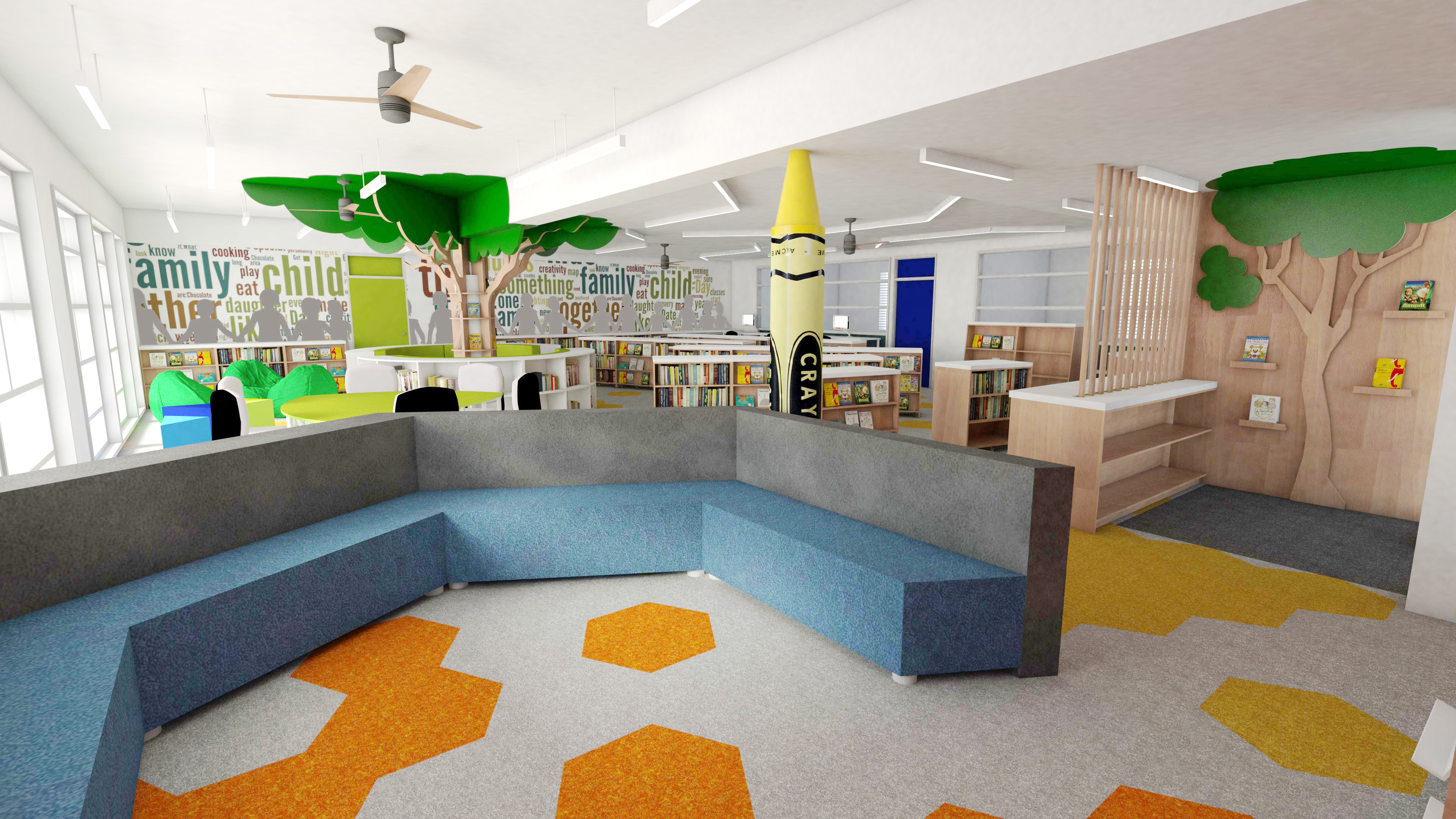
When our local MP, Natalie Suleyman, visited the school we talked about our vision for Monmia, and the first priority we named was valuing books and reading. We wanted a library that showed we take education seriously. Sometime after her initial visit, Natalie returned with a cheque for $100,000, and our Family and Friends Committee donated a further $20,000. That funding allowed us to reimagine the space so that it was light and open, with as many front facing books as possible, places for classes to gather for read alouds, and cosy nooks where children would actually want to stay and read. There is a card in the library from a parent that sums it up beautifully: “What a school’s library looks like tells you how much it values education.”
Did you involve staff, students and the broader community in identifying what the refurbished library needed to better support learning?
Absolutely. Student voice was central to the process. Each class completed a survey asking what, in an ideal world, they would like in their library. Among the fanciful suggestions like rocket ships, there were strong themes: they wanted a bright space, places to curl up with a book and something for everyone. I summarised the student ideas and then posed similar questions to families. Those responses were also collated and taken into our planning.
We then worked with the architects, using these ideas alongside a very clear picture in my own mind of what the space could be. Because we are a Be You school, every child made a butterfly from newspaper to symbolise transformation, which we displayed in the library. Staff with artistic flair drew the outline of the feature tree and created signage for our Harry Potter exhibition. The result is a space that feels like it genuinely belongs to the whole community.
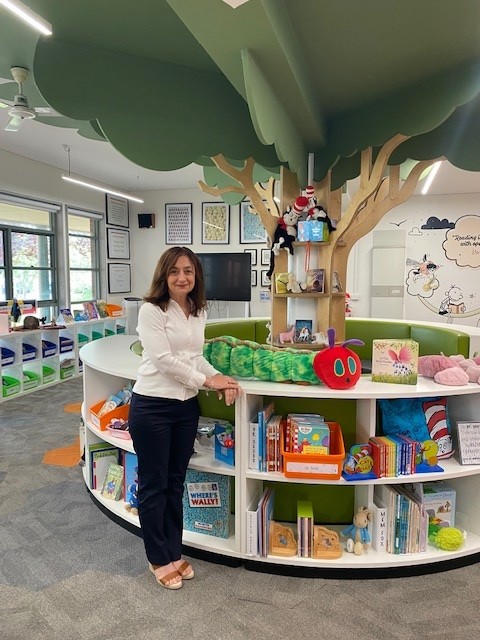
Principal Lucia Vorpasso in Monmia Primary School’s library.
Refurbishments often require balancing ambition with practicality. How did Monmia prioritise which elements to refresh, repurpose or completely rethink?
At first glance, $100,000 sounds like a lot, but it does not go as far as you think when you are refurbishing a whole library. We also had some structural constraints: we could not move some support poles or extend the footprint of the building. That meant we had to be very clear about our non negotiables.
The top priority was open shelving with front facing books so that covers could be seen easily. We knew that spine out shelving was uninspiring for many children. Our furniture choices flowed from that goal.
Working with a consultant from Raeco, we refined the shelving and seating several times until it matched our vision: open shelves, circular seating around the tree feature, and flexible areas for children to settle in with a book.
The poles that we could not move became design features. One was transformed into the trunk of a tree, with branches and leaves extending across the ceiling. Another was turned into a crayon, carrying phrases such as “read to learn, read to play, read to laugh, read to connect”, along with our school motto. We also curated special zones, such as a Harry Potter exhibition and a back wall covered with quotes about reading and its possibilities. Teacher resources were moved out to a dedicated resource room so that the entire library floor could be reserved for children. In the end, we feel we achieved everything we wanted within the constraints, and we have continued to layer in small additions over time.
Since the refurbishment, what tangible differences have you seen in students’ engagement, learning behaviours or sense of belonging in the library?
The change has been remarkable. Before the refurbishment, classes would come in, collect books and go straight back to their rooms. Students didn’t want to stay in the library because it wasn’t an inviting space. Now every class is timetabled for an hour a week in the library, and most children borrow regularly. More importantly, they want to be there.
When we first revealed the refurbished library, we did it “renovation show” style, with blinds down and only small sneak peeks in the lead up. When students finally walked in, their faces said everything. We captured their reactions and have some of their quotes displayed on the wall. Seven years on, the sentiment behind those quotes has not changed. The space still looks almost as new because the students value it and look after it.
Our reading data has improved and we are continuing to build on that. The biggest shift has been in the narrative the school community has around books. Classrooms now have their own mini libraries that echo the main library, and it is very clear to everyone that Monmia is a school that values reading. The library has also achieved external recognition in a refurbishment competition. While the State Library took out the top spot, our library was highlighted as an example of what can be achieved on a much smaller budget.
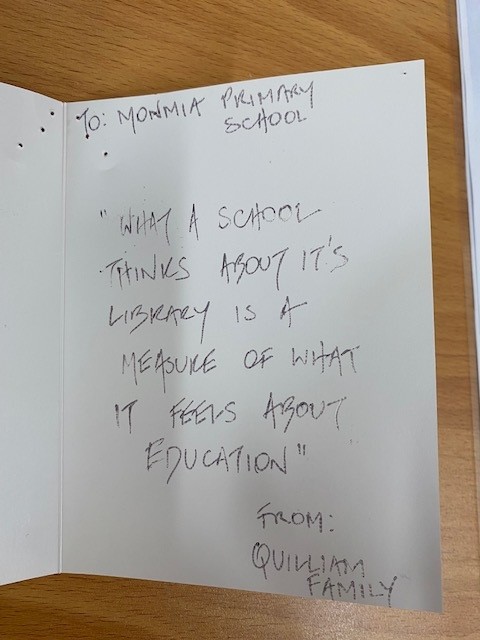
A note from the family of a child who attended Monmia Primary School.
How has the redesigned library influenced teaching practice or the way staff integrate the space into everyday learning?
The refurbishment has given teachers a clear purpose and structure for their time in the library. We have an instructional model specifically for the library. A class often begins with a whole class read aloud in a special reading chair, with students gathered around. Teachers then use that text as a springboard for discussion and questioning, modelling the kinds of conversations we want children to have about books.
After that, teachers move into mini conferences with students while other students are choosing books. They will sit with a few children each week, ask about their reading preferences, talk about genres and make individual recommendations. Those small conversations have enriched the way we talk about reading and have helped students discover new interests.
What aspects of the new design have had the greatest long term impact on staff and student wellbeing, inclusion or access to learning?
For me, the library has become our calm, inclusive heart. It is a beautiful, peaceful space where staff will sometimes retreat when they need a moment of quiet, and some of our therapy work with students takes place there because it feels so safe. One deliberate design decision was to remove rows of tables and replace them with nooks and flexible seating. I did not want the library to be dominated by desks and worksheets. I wanted children spread out, reading independently or with a friend, and that is exactly what now happens.
We have also embedded wellbeing and inclusion into the way we curate the collection and displays. We have a dedicated wellbeing display with feelings books and stories that explore everyday challenges like bullying or family separation in gentle, age appropriate ways. We use picture books to open up conversations about life skills and relationships, not just reading skills. Our ANZAC wall links to a memorial garden outside and allows us to talk about empathy and gratitude in ways that make sense to younger children. Other focal areas highlight multicultural Australia so that students can see their own backgrounds reflected and celebrated.
The library has strengthened our connections beyond the school as well. Our local Ray White office sponsors student leadership and chose to hold a staff meeting in the library, which prompted a wonderful moment of adults reconnecting with books that were their childhood favourites. We also have an on site kindergarten, and they visit weekly to borrow books. We are working towards a dedicated four year old reading group with them, to help them engage with reading in their early years.
Out of my whole career, that library refurbishment remains one of the highlights. The architects from AOA Christopher Peck gave us the canvas through their design and project management, and we have filled it with what we know best: reading, education and community. Together, that combination continues to support our students’ learning, wellbeing and sense of belonging every day.