Issue 139
Term 4, 2026
Study skills in action: how the school library builds independent learners
Students with strategies for studying are learning more than just how to prepare for a test: they’re learning to have agency and be resilient and proactive. Natasha Georgiou explains how her school library approaches developing study skills.
At Kennedy Baptist College, the Research and Study Centre, known as the RASC, is a teaching and learning hub where research, study skills, academic integrity, digital literacy and student wellbeing intersect. Our aim is to help students become confident, independent learners who know not only what to study, but how to study effectively.
The RASC delivers a structured research and study skills program from Year 7 to Year 12. Students are taught how to organise their learning, take and transform notes, summarise information, plan revision, use active recall, prepare for assessments, research effectively and act with academic integrity. This support continues across the secondary years. Year 9 students receive exam preparation sessions; Year 10 students delve further into strategies on how to avoid plagiarism; Years 11 and 12 are supported with exam preparation, study planning and senior school strategies; and Year 11 students complete academic integrity modules covering collusion, paraphrasing, plagiarism scenarios and citations. The RASC also provides individual study skills sessions when requested by teachers, parents, heads of year, counsellors or students themselves.
While the program extends across the whole school, this article focuses on the foundation years: Years 7 and 8. Students in these years are adjusting to new routines, managing multiple subjects and teachers and forming habits that will shape their later learning.
Building the foundation in Year 7
Our study skills program begins in Year 7 with SMARTS: Sevens’ Mature Approach to Reasoning Techniques and Study. SMARTS introduces students to core habits and strategies they will return to throughout secondary school, including organisation, note-taking, summarising, growth mindset, study planning, timers, repetition, flashcards, memory tools, test preparation and mind maps.
The purpose of SMARTS is not to turn Year 7 students into expert learners immediately. Rather, it gives them a shared vocabulary and a practical toolkit. Students learn that organisation is a skill, not a personality trait, that study is different from homework, and that effective revision requires more than rereading or highlighting.
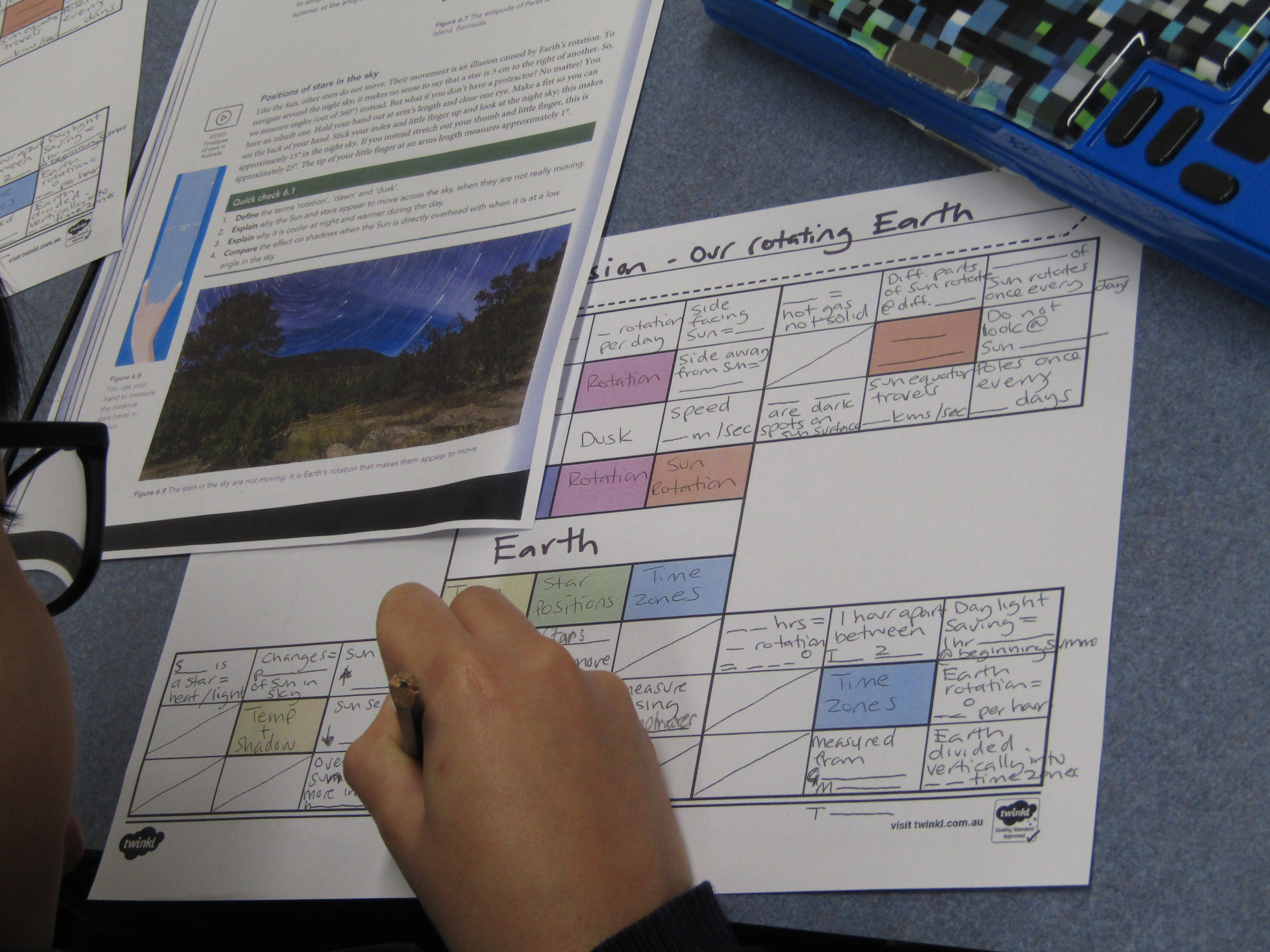
This foundation matters because study skills need to be revisited. Students rarely adopt a strategy permanently after just one lesson. In Year 7, we reinforce SMARTS through a practical Earth and Space Science test preparation workshop. Students use active study strategies such as flashcards, summarising notes and lotus diagrams. We also introduce effective group study, discussing how to work productively with others rather than simply sitting together and becoming distracted. Students practise asking questions, testing recall, explaining concepts aloud and sharing strategies. Practical applications, such as using mini Oreos to represent the phases of the moon, make learning memorable. This gives students a concrete opportunity to apply study strategies to real curriculum content.
Year 8 Study Smart: revisiting, refining and applying
In Year 8, we revisit and extend these ideas through our Study Smart session. Delivered through Homeroom during Pastoral Care Time, the session reaches the whole cohort in a consistent, practical way. Its structure is simple and transferable: Reflect, Take Action and Go To.
The opening hook is deliberately relatable: students imagine it is 9.47 pm and they suddenly remember they have a test the next day, but their notes are missing and their motivation is gone. The aim is to help them ‘study smart – not harder, not longer … just smarter’. Teacher librarians visit every Homeroom, answer questions and reinforce active participation. Students take Cornell notes during the instructional video, and treats are provided for students who produce acceptable notes, reinforcing that note-taking is an active study strategy.
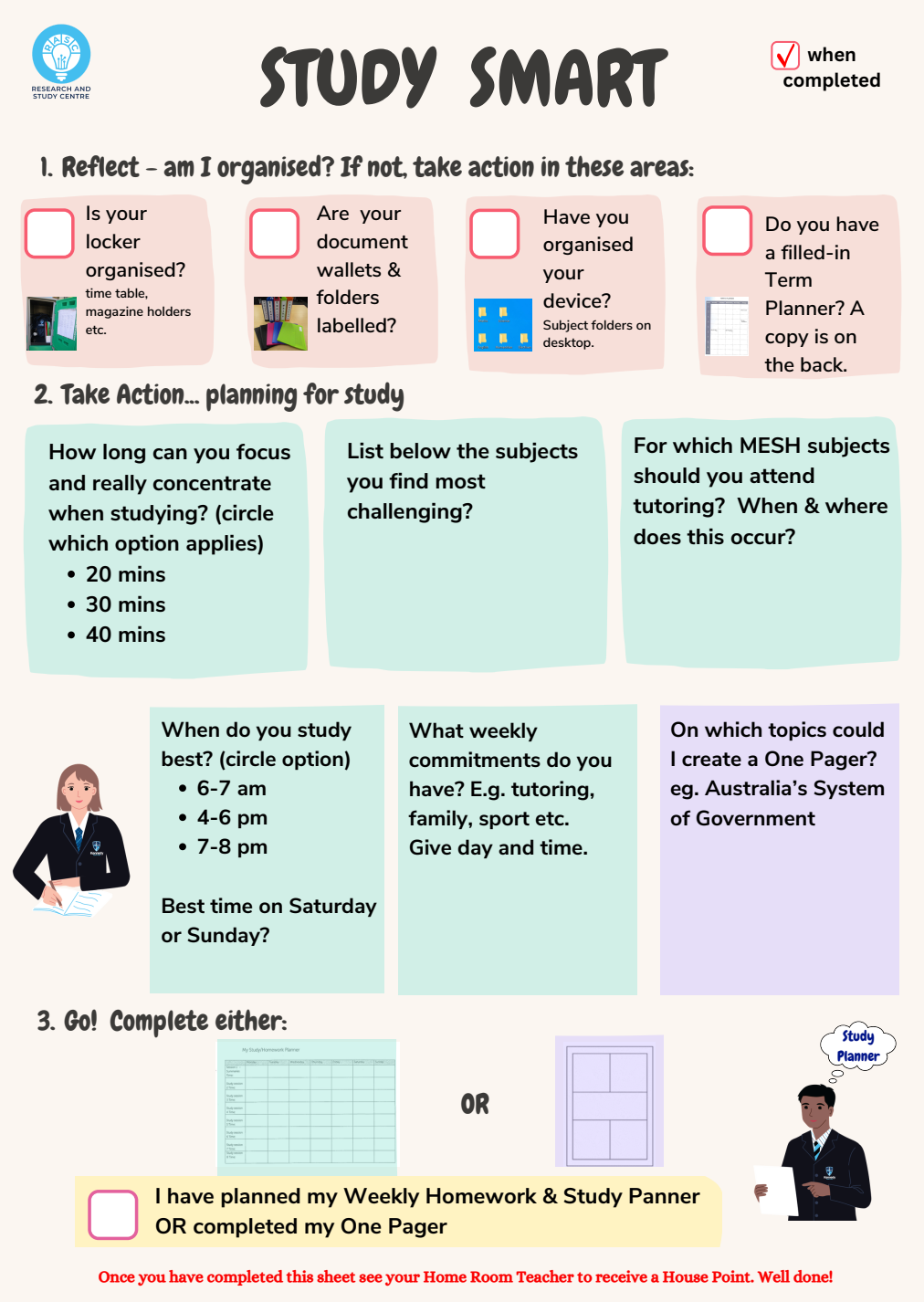
Yr 8 Study Smart Student Checklist
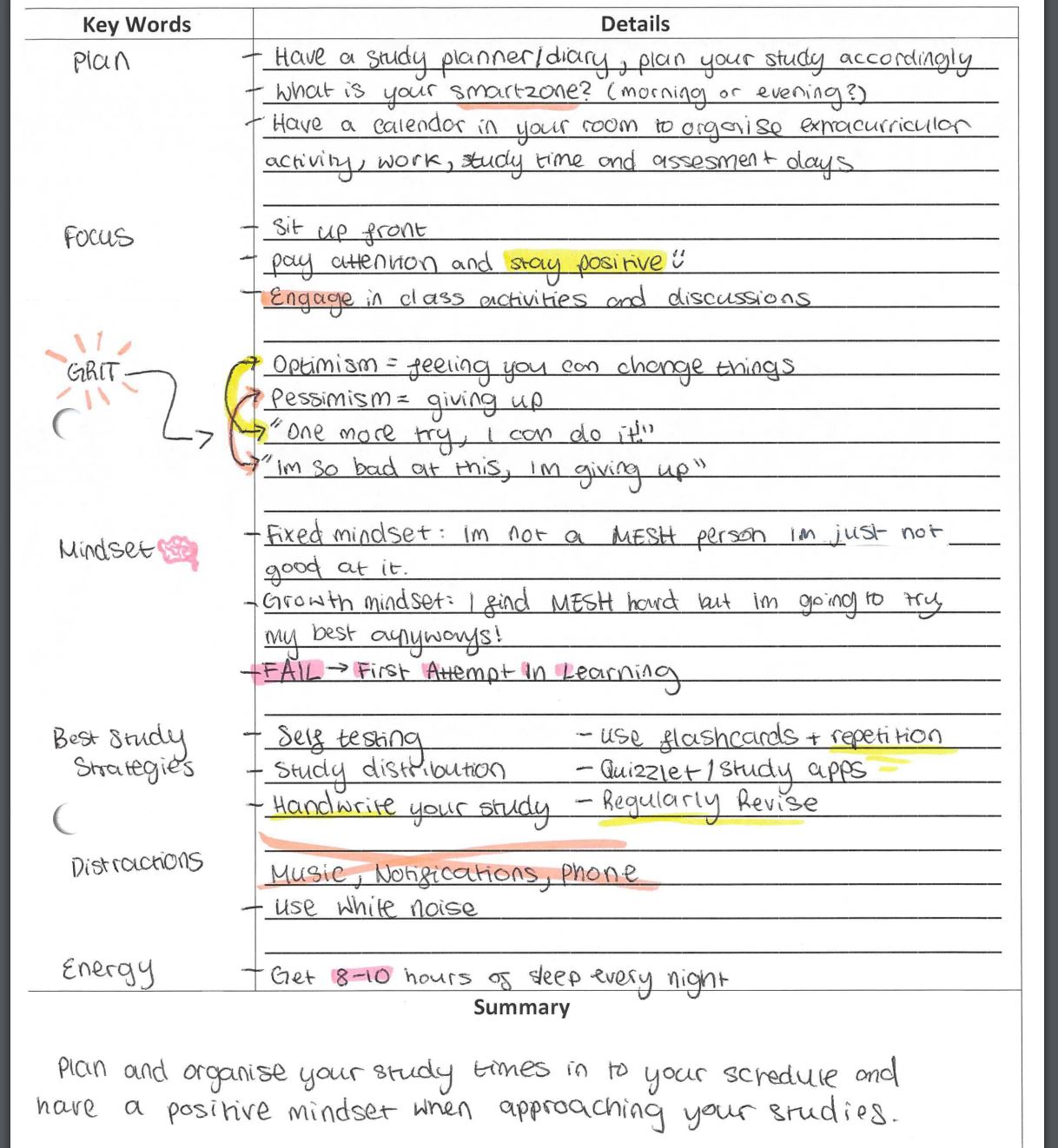
Cornell notetaking example
In the Reflect stage, students consider their organisation. Is their study zone at home working well? Are devices, noise or shared spaces affecting concentration? Are folders, document wallets, device files and lockers labelled and organised? The worksheet turns reflection into action by prompting students to update their term planner, organise subject folders or tidy their locker.
In Take Action, students focus on planning. They revisit the idea that their diary is a ‘power tool’ because it contains term planners for deadlines and weekly planners for homework and study. They clarify that homework is set by a teacher and has a due date, while study includes reviewing notes, writing summaries, practising, memorising and preparing for assessments.
Students then plan realistically. The worksheet asks when they study best, what commitments they already have, which subjects they find challenging, which MESH subjects they may need tutoring for, and how long they can genuinely focus. The model weekly planner breaks homework and study into manageable blocks, mostly around 30 minutes, with short brain breaks.
In Go To, students match study strategies to learning needs. Facts, terms and keywords suit flashcards and Cornell notes. Processes, events and topic overviews suit mind maps, lotus diagrams, one-pagers and summaries. Information in a specific order can be supported by mnemonics such as acronyms, acrostics, rhymes and songs. For focus and procrastination, students are reminded to set a purpose and then use a timer.
The session also introduces retrieval practice through a simple brain dump: students write or draw everything they can remember about a topic without using notes, then check what they missed. Another key strategy is the one-pager, where students present key information on a single page using words, images, colour, symbols, mnemonics and graphic organisers. The process is modelled: choose a topic, select key points, choose or design a graphic organiser, create the page, then enhance it with extra information in the border.
At the end of the session, students complete the Study Smart handout and then choose a practical task: either completing a weekly homework and study planner or creating a one-pager. Students who successfully complete the handout are awarded a House point, adding motivation and accountability. Most importantly, students are not simply told about study strategies; they use one before the session ends.
The library as a study skills partner
The success of this program relies on collaboration. The RASC works with teachers, pastoral care staff, Heads of Year, parents and students to ensure that research and study skills are not isolated from classroom learning. What makes the library well placed to lead this work is its whole-school reach. Teacher librarians can notice patterns, respond flexibly and provide continuity.
Ultimately, study skills are part of learning how to learn. When school libraries teach these skills explicitly and repeatedly, they help students build confidence, independence and resilience. Effective study is not magic. It is a set of strategies that can be learnt, practised and improved.

Natasha Georgiou
Head of Research and Study
Kennedy Baptist College, WA