Issue 138
Term 3, 2026
Megan Daley, busy bee
I sat down with Megan Daley to learn about her hacks for stealth-marketing reading to children.
I spoke to Megan Daley first thing on a Wednesday morning.
Megan Daley: Hi, how are you?
Ceinwen Jones: Hello, good! How are you?
MD: Yeah, I’m good. Good … Actually, I had a weird morning. I just, I woke up at 3 am with a bug in my ear and I’ve just been to the GP and had it removed. Like, I’ve literally just walked back in from the doctor. So that was my morning.
CJ: Oh! Wow, that’s so random!
MD: I know, so weird. And I’ve got one meeting after another today and I just feel a bit weird. I’m just … anyway, I managed to get a coffee on the way back from the doctor, so that’s good.
CJ: Oh. So things are looking up?
A perfect day would have some writing, some reading and some talking.
MD: Yeah, that’s right. How are you?
At this point, I was kind of wondering if I should ask Megan if she wanted to reschedule … was she really OK? She seemed OK, and they’d got the bug out. I pressed on.
CJ: Oh, I’m fine. But, while preparing for this interview, the overwhelming thing I wanted to ask you was, have you somehow found some way to put more than twenty-four hours in a day? Because it seems like, you have four kids, you’re a writer, you’re a speaker, a podcaster, an artistic director of a festival, you have a website, you’re part of publishing a series. I don’t understand.
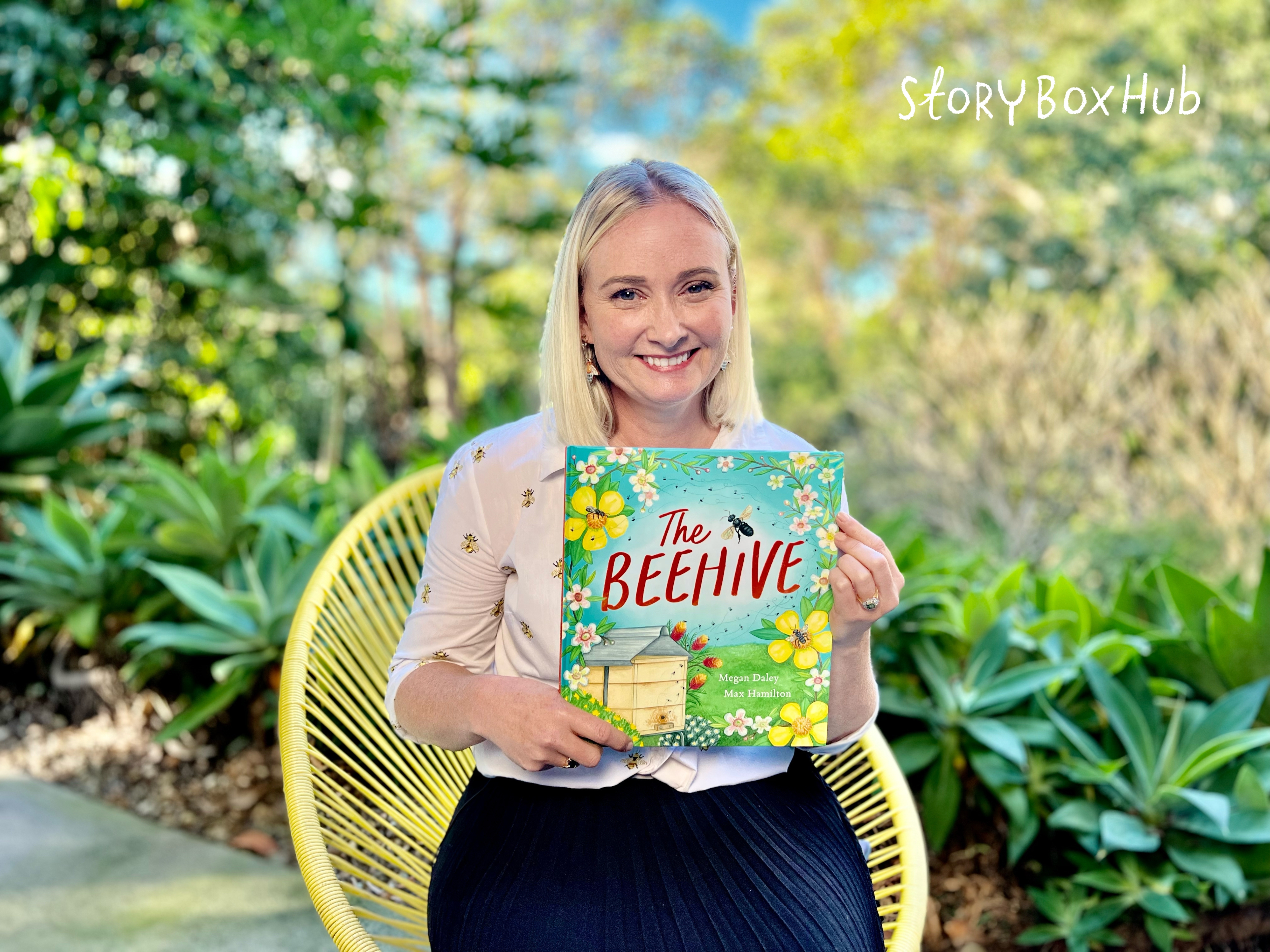
MD: And I work for StoryBox Hub [as Head of Education] three days a week now as well.1 I’ve left my teaching job. That was my three days. And then I’m Storyfest one day a week, and then I’m author, publisher one day a week, and then I’m podcast one day a week, which leaves one day for parenting and children. But that’s fine.
CJ: But what about personal care?
MD: Who needs that? I’ve just been to the GP to get a bug removed. That was my personal care.
CJ: That’s right. Did they get it out with the tweezers?
MD: A tiny vacuum.
CJ: And what kind of bug was it?
MD: They couldn’t tell, something very little. When I said my husband was a beekeeper, they were like, oh, we hope it’s not a bee.
CJ: A bee would be a bit big though to get out – it could get stuck.
MD: A native bee. A native bee would get down your ear pretty easily. Yeah, I’ve swallowed one of those recently. I was talking at a school about native bees and about my book [The Beehive] and I was opening up their beehive as I was talking and one flew into my mouth and I swallowed it in front of 200 kids!
CJ: Oh, did it bite you on the way down?
MD: No, they [native bees] don’t bite. They don’t have a stinger. Just didn’t taste very nice! And I traumatised all of the prep children in front of me.
CJ: Well, you taught them that it’s OK to swallow a bee, and you’ll survive. But I guess the events leading up to the survival might have traumatised them a bit if you were distressed, I suppose.
Now you may be wondering, did I talk to Megan about anything other than insects? The answer is, yes, mostly. We also talked extensively about reading.
Megan has a lot to say about the importance of reading for pleasure and its far-reaching benefits. But you may be surprised at her take on it.
MD: I’ve really changed my thinking around … that our kids should just want to pick up a book. I’ve given up on [the idea that] my kids are just going to naturally want to fall into reading. I think it’s a discipline to be able to read a book, but also it’s a slowness. It’s a stillness in your mind. It’s a ‘the answer’s not coming straight away’ kind of feeling. It’s a really important thing for children to experience and go through.
Megan talks more about reading as a discipline in terms of her expectations as a parent and as a teacher: she has an expectation that her four kids will read every single day. It doesn’t always work out that way, but the expectation is there in the same way as PE teachers insist on exercise and piano teachers insist on practice. Reading is a skill, just like playing sport or playing an instrument is a skill, and it’s not necessarily something that a child will naturally just do, but it’s important to have the expectation that they’ll practise it and persevere with it.
Parents and teachers and library staff can also take advantage of other methods to supplement the disciplined expectation that children get into reading as a habit. ‘Fake it till you make it’ may be apt in this case: I know at least one child who has followed BookTok influencers and gotten into the aesthetic of identifying as a reader before actually becoming a reader for real.
The same goes for the children who enthusiastically and excitedly borrow books from the library for a term without reading any of them, just carrying them around as an accessory; or those who will happily read low-quality series, much to the chagrin of all the adults in their lives, but nothing else. Perhaps you have children coming into the library to read a book because it was written by their parents’ favourite celebrity. All these behaviours are like gateways leading towards the habit of becoming a lifelong reader-for-pleasure, and should be encouraged, and scaffolded upon.
This philosophy may be akin to prioritising quantity over quality – that is, prioritising the habit, rather than the books or reading materials themselves – but when it comes to scaffolding, are we really, as educators, doing enough of this next step, Megan wonders.
MD: The other thing that I think is happening is with the decreased attention spans of children – or the assumed decrease in attention spans – a lot of middle grade books are now being studied in senior secondary. Books that were intended as YA books are almost considered too long to study in a school and they are studying shorter books with shorter chapters. And you know, that worries me as well because I think children need to develop their reading stamina. And I hope that schools are making decisions based on the quality of the book, not just the length of the book.
Unsurprisingly, Megan is a wealth of knowledge about stealth (and not-so stealth) marketing for books and reading. You may have a friend who’s expert at sneaking vegetables into their children’s food. You may have another friend who’s really good at gamifying chores or boring tasks so that their housework gets done. Well, Megan is really good at carving out time to read, and at getting other people to read. Here are the top tips I gleaned during our chat.
- Carry books around with you, so you can read in the little pockets of time afforded to you (for example, when you’re at the GP, waiting for a bug to be removed from your ear).
- Bonus: if you carry picture books, in particular, around with you, people will often ask you why. And then you’ve started a conversation – more stealth marketing.Audiobooks can be an incredibly motivating tool to get through
- housework
- road trips (if she can find something that suits everyone, Megan claims all four of her kids won’t argue in the car)
- Leave picture books on the kitchen table all the time. Megan says, ‘I find when I first get up in the morning and I’m having my first cup of tea or coffee for the day and I’m waking up, a picture book isn’t taxing on time [or energy], and because I have them physically in front of me on the kitchen table, it’s easy.’
- This works on others too: ‘If I want the kids to read something, I just leave it around. And then they just ‘accidentally’ come across it.’
- When kids are borrowing from the library, before they leave, get them to start reading the book they’ve borrowed before leaving. ‘[When I was a teacher librarian], I always allowed time for borrowing where afterwards I made the kids sit down and start reading the book they’re going to take home, because once you start a book, you’re more inclined to finish a book.’ While they may forget about the book if they’re rushing to borrow and just throwing it into their library bag, if you start them reading that book, well, as Megan says, ‘Authors are very clever at hooking people in.’ Your job is to get them to start.
- Use books as decor: ‘I don’t know. Other people put flowers on their kitchen table. I decorate my kitchen table with picture books.’
So maybe the aesthetic of identifying as a reader never really leaves you? We finished the interview with Megan describing her perfect day, and I’ll leave you with it too.
Oh, the perfect day would be a coffee first up and some sourdough fruit toast, and reading some of the picture books on my kitchen table. If it was a weekend, I would then go through my recipe book collection and read all of the recipes that I really, really like and meal plan and then I would be left alone to do some writing. At the moment I’m writing a book for the ‘Your Next Read’ series [but] I’ve always got a writing project underway. And then I’d probably like to talk to Allison Tait and record an episode of the podcast because we talk every single week and it’s like therapy. [When] we record the podcast, it doesn’t feel like we’re recording it for anybody else. It’s just a conversation. So I really enjoy that. And definitely honey. There’s honey on everything. In fact, there’s honey on the sourdough fruit toast. There is honey in most of my recipes ’cause I try to replace sugar with honey. Always some honey.
-Megan Daley

Megan Daley
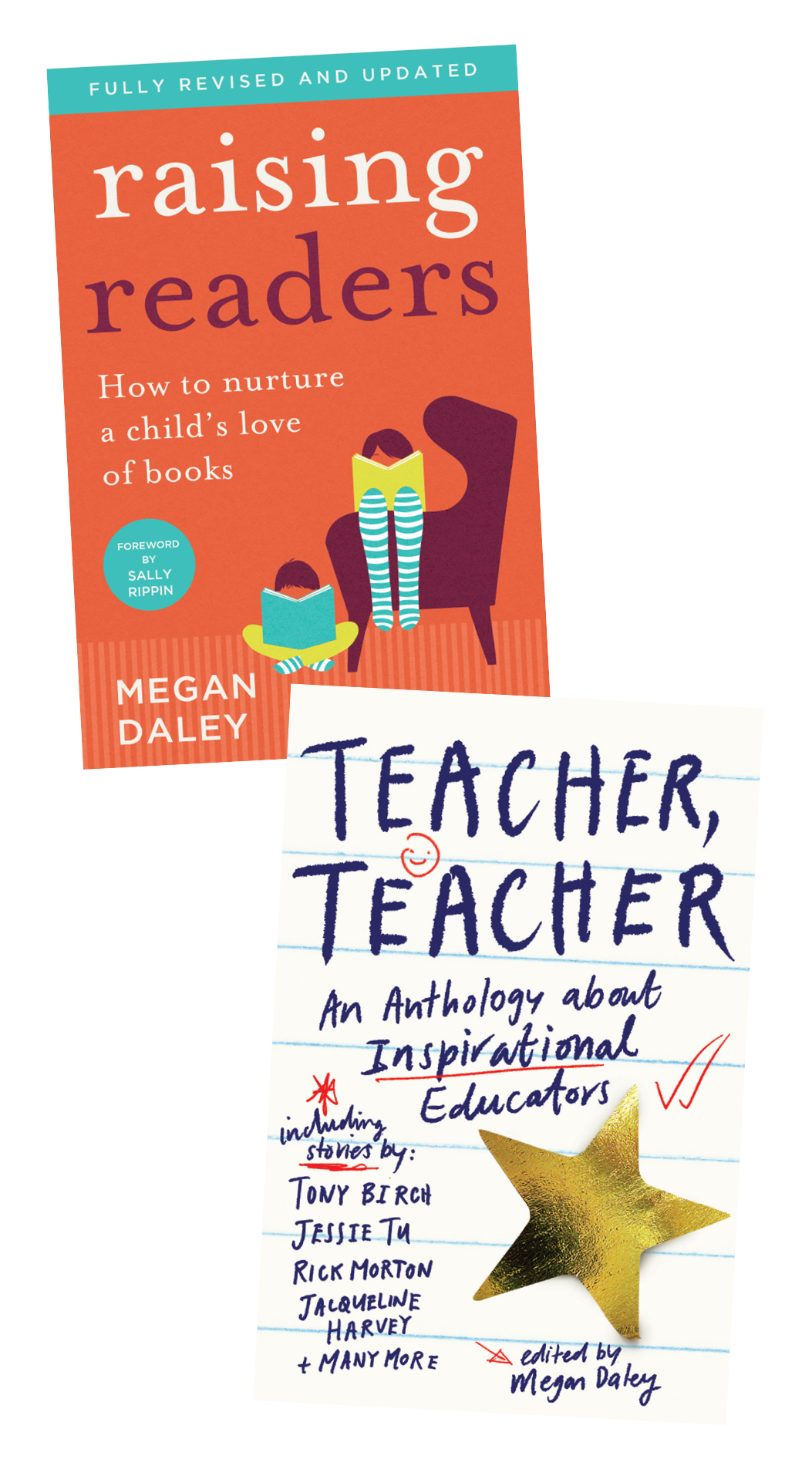
Head of Education at StoryBox Hub, co-founder of Your Kid’s Next Read and Artistic Director of Somerset Storyfest.