Issue 137
Term 2, 2026
How to build a collection for purpose, with purpose
Why more information is not the answer.
Since generative AI (GenAI) leapt into public view with ChatGPT in late 2022, the conversation about AI in schools has felt relentless. Journals, professional learning, conference sessions and social media are saturated with frameworks, tools and opinions. At first, this avalanche sparked lively reflection on our use of digital technologies (Selwyn & Szili, 2025). Over time, though, the pace and volume of material have left many feeling overwhelmed. Some people feel they must read everything to keep up, and others simply switch off (Stillwaggon Swan, 2025). When there is too much information, meaning gets lost and decisions can become reactive, people feel stressed and misinformation is more easily spread (Harvey, 2025; Shahrzadi et al., 2024).
As school library professionals, sensemaking, synthesis and curation sit at the core of professional practice. It’s time to promote this expertise, as making meaning and guiding others through information overload is an incredibly valuable contribution we can make in this area.
From volume to value: why we need curation, not collection
Curation is not about saving everything that looks vaguely useful or sharing every link that crosses a screen. It is a deliberate process of selecting, annotating and sharing with intent and purpose (Cameron, 2023). Saving articles ‘for later’ may feel productive, but it is collecting, not curating. Chimero (2011) captures the difference between collecting and curating when he compares a bowl of loose pearls to a pearl necklace. Individual pearls may be valuable, but it is only when they are selected, ordered and strung together that they gain meaning and purpose. Collecting is additive. Curation is selective and often subtractive. It turns accumulation into something usable, coherent and worth sharing
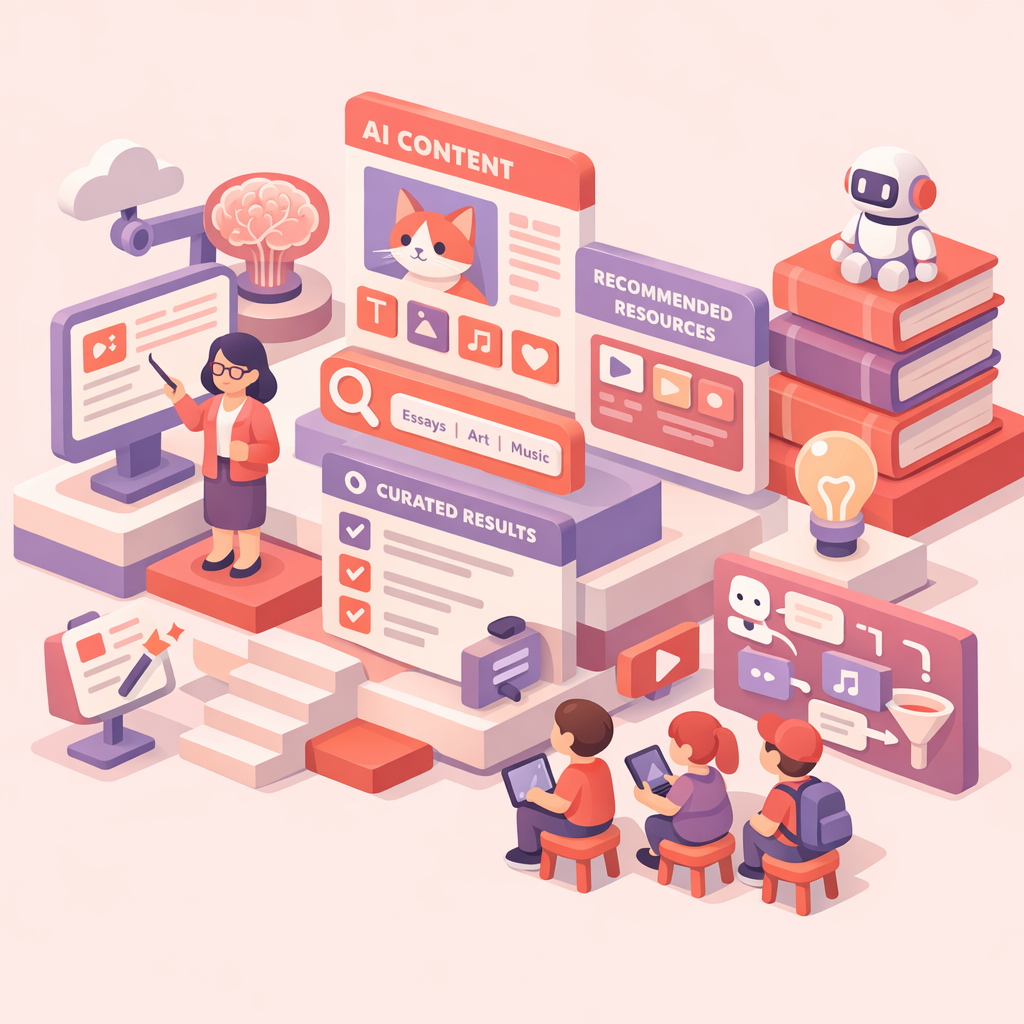
Image by Copilot with prompt “imagine a world where librarians are curators and guides for the enormous volume of gen ai content that students need to contend with.”
School library professionals as expert curators: established practice in action
Evaluating sources, synthesising ideas and sharing information where it will have the greatest impact is part of everyday work for school library professionals. Whether it is finding the perfect picture book for a Foundation year student, identifying a reliable website that is also at the right reading level, or selecting teaching resources for a newly developed unit of work, decisions that balance authority, relevance, currency and context are made frequently in school libraries. This means that school library professionals are expert curators who can apply these transferable skills to any topic; and no information topic requires curation more than GenAI and its impact upon education.
Curating GenAI information: applying professional judgement
When faced with multiple sources competing for your (and your school community’s) attention, applying these strategies can make the evaluation process easier.
- Investigate the credentials of the author or creator. Is their background in education, computer science or sales? What did they do before GenAI became their focus? What are their qualifications, and in what field?
- What is the intent of the article? Is the article providing useful guidance, or is it marketing disguised as advice? The blurring of boundaries between information and advertising can make this a challenging but important decision.
- Whose voices are not being heard or represented? As algorithms increasingly drive similar content based on previous engagement, it is vitally important to seek out a range of sources to ensure you are curating a balanced, unbiased set of resources and information.
These are strategies similar to what we teach students when scaffolding critical evaluation skills; but it is easy to forget that they should also underpin our own professional judgement.
Contextualising the works: making meaning for your school
Every school is at a different stage in its engagement with GenAI, and resources that are useful in one context may not be appropriate in another. Interpreting information through local values, priorities and needs requires an understanding of the school community and its day-to-day realities. Developing a small, high-quality and trusted resource hub tailored to a specific school is often more effective than relying on large discussion lists or generic professional learning designed for broad audiences.
Timing and restraint also matter. Periodic updates that highlight one or two carefully selected resources can be more impactful than frequent alerts. Sharing a high-value article or tool once or twice a term allows time for reflection and discussion and is more likely to support meaningful engagement than regular newsletters filled with links that few have the capacity to explore.
Everyday strategies for reducing overload
What earns space
Before adding a resource, check it against a small, consistent set of criteria.
- Is it directly relevant to current teaching, learning or governance priorities?
- Is the advice supported by evidence, research or credible professional experience?
- Is the author appropriately qualified for the type of guidance being offered?
- Does it add something new or clarify thinking, rather than repeat existing material?
If a resource cannot clearly meet these criteria, it may not need to be included.
What stays off the shelf
Deciding what not to share is an essential part of curation.
Consider steering clear of:
- resources driven by hype or urgency rather than substance
- promotional content that positions a product as a complete solution
- generic advice that does not translate easily to your school context
- duplicates of information already available in your curated set.
Holding these back helps reduce noise and protects colleagues’ time.
How to label and frame Well-framed resources are more likely to be used.
- Add a short annotation explaining why the resource was selected.
- Indicate who it is most relevant for and how it might be used.
- Highlight one or two key takeaways rather than sharing a long summary.
Curatorial leadership: guiding without overwhelming
Schools do not need every resource, framework or response to move forward with confidence in the area of GenAI. What they need is thoughtful curation grounded in professional expertise and local context. School library professionals bring discernment to complex information landscapes, making careful choices that prioritise clarity over volume. This work is not just practical; it is ethical. Deciding what to share and what to hold back protects time, attention and wellbeing across the school community. Trusting in professional judgement and focusing on context-aligned guidance allows schools to develop responses to the challenges of GenAI with purpose rather than urgency. In crowded information spaces, thoughtful curation creates clarity, confidence and calm.
References
Cameron, J. (2023). Content curation: Best practices and techniques. In A. Krowinska, C. Backhaus, B. Becker, & F. Bosser (Eds.), Digital content marketing: Creating value in practice (pp. 169–188). Routledge. doi.org/10.4324/9781003346500-9
Chimero, F. (2011, June 27). Sorting a mass. FrankChimero. frankchimero.com/blog/2011/sorting-a-mass
Harvey, M. (2025, April 15). Make believe and misinformation: A guide for cutting through information overload. State Library of Victoria Blog. blogs.slv.vic.gov.au/our-stories/ask-a-librarian/make-believe-and-misinformation-a-guide-for-cutting-through-information-overload
Selwyn, N., & Szili, A. (2025). The role of ‘AI advocate’ teachers in mediating technological change across Australian schools. Teachers and Teaching, 1–16. doi.org/10.1080/13540602.2025.2596832
Shahrzadi, L., Mansouri, A., Alavi, M., & Shabani, A. (2024). Causes, consequences, and strategies to deal with information overload: A scoping review. International Journal of Information Management Data Insights, 4(2), 100261. doi.org/10.1016/j.jjimei.2024.100261
Stillwaggon Swan, L. (2025, September 9). Suffering from AI fatigue? You’re not alone! Psychology Today. psychologytoday.com/au/blog/the-philosopher-is-in/202509/suffering-from-ai-fatigue-youre-not-alononfidence and calm.

Kay Oddone
Senior Lecturer, Course Director Master of Education (Teacher Librarianship)
Charles Sturt University