Issue 137
Term 2, 2026
Andy Griffiths: King without a crown
Connections editor Ceinwen Jones sat down with Andy Griffiths to chat about appropriate children’s literature, different ways of depicting diversity, authenticity in storytelling and inventing AI.
I’m not going to lie, I’m slightly disappointed in the Australian Children’s Laureate Foundation, because upon meeting this year’s laureate, Andy Griffiths, I discovered he had not yet been given a crown – or even a laurel wreath – to mark his 2026–27 reign. He seemed unsure whether he would ever receive one, saying, ‘They haven’t sent me one yet, but I already have my cardboard box adventure helmet, which is the only headgear I need. It keeps me safe on all my adventures—both real and imaginary.’ They are lucky he is a versatile and forgiving person. In Andy Griffiths, Australia has a children’s literature advocate who is serious, funny, thoughtful and articulate, with an imagination that has kickstarted generations of lifelong readers. As a kid, Andy liked creating little magazines and jokes and comics for the entertainment of his friends and family. He thinks that Child Andy would have been pleased to know that Adult Andy still gets to do that. ‘I think he [Child Andy] would be delighted to know that he will avoid having a “proper” job all his life and will continue on with the same playful messing around that he enjoys so much at school.’
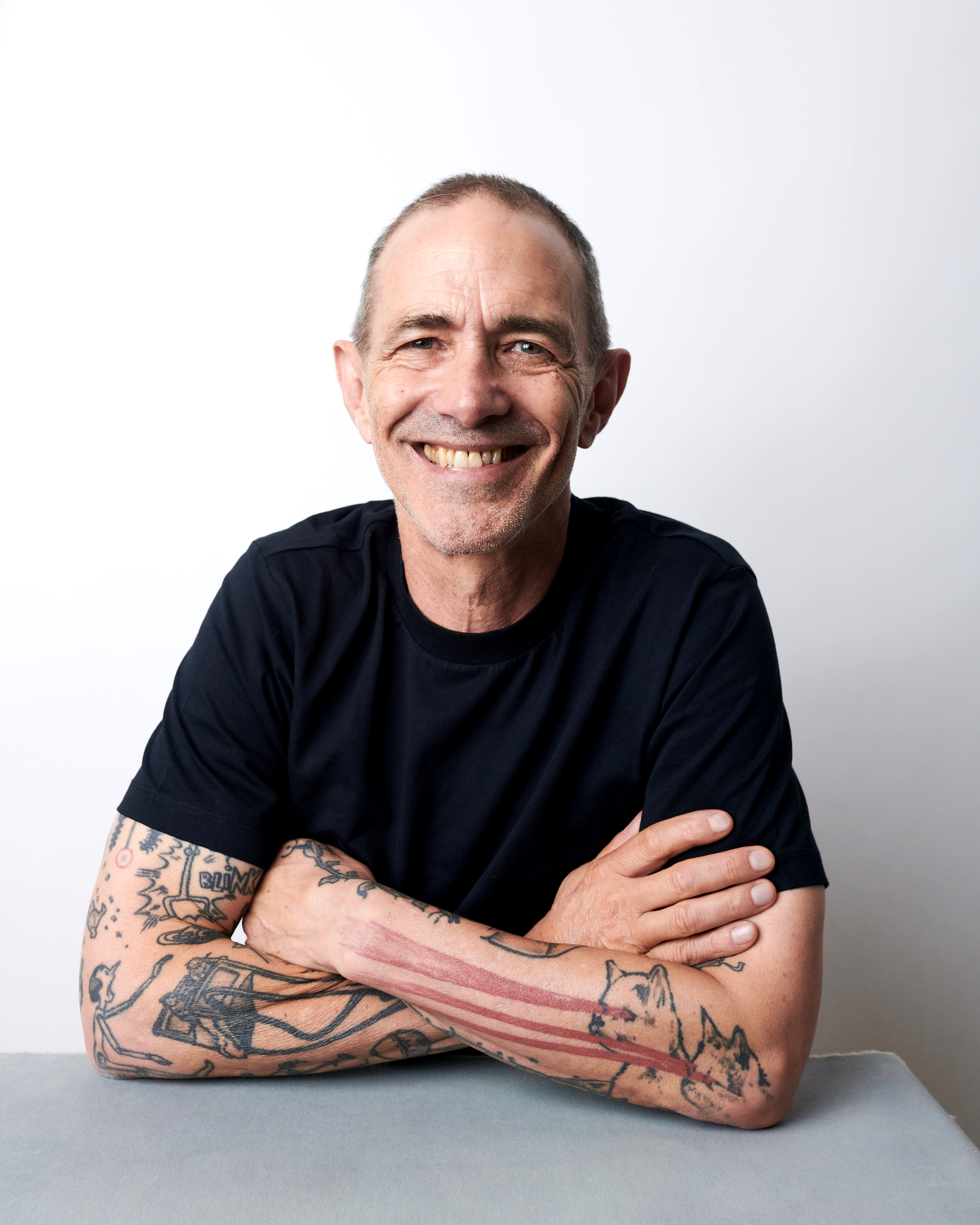
Ceinwen Jones: You like humour in the absurd and you identify with Holden Caulfield. Would you say you’re a little bit of a Peter Pan? And do you think all children’s authors have that quality?
Andy: I think all children’s authors, to quote Roald Dahl, have a solid block of childhood within them. And then to quote Morris Gleitzman, the window stays open for children’s writers so that you can go back through that window any time to enter the mindset of a much younger person. And it doesn’t mean that you act like a child all the time, because I can be an adult when I need to be. But when I pick up a pen, it’s the child who takes over … and my adult self is really just there to supervise and edit and negotiate with the other adults.
Andy has thoughts about libraries, censorship and the role of adults as gatekeepers of what children read – and he has a story that will make you check whether you have an up-to-date Challenged resources policy for your school library!
Andy: [In the early years] there was a small number of people, gatekeepers, who thought I was encouraging kids to be crazy, out of control and disobey their parents. And I said, ‘I think kids can tell the difference between real life and what’s appropriate in a book. And the reason they enjoy my books is because they know my characters are actors, acting way outside the bounds of common sense, and sometimes decency, but they always get some sort of comeuppance. They don’t get rewarded for that behaviour. And it does not encourage kids to act like those characters in real life. That’s the cathartic benefit of reading and also of humour … that you can entertain the most outlandish ideas and not have to do it yourself. So that’s what I feel I spent the first 10 years of my career explaining … And many adults came around when they saw the kids just rolling on the floor laughing as I presented, and then rushing for the library to read those books.’
CJ: Which is not the kind of crazy behaviour that your critics might have been dreading: rushing to the library.
Andy: No, and my readers are some of the nicest kids you’ll ever want to meet. As I hope I was in many ways, but I was attracted to the dark side and the crazy side in my reading. And I guess that’s where I came in and I thought, there’s not enough of that going on in modern children’s literature – we’re losing them to television and movies, which don’t have this idea that everything should be a message that we can learn from – which I think books somehow got saddled with.
When publishers told Andy that his books were entertaining but they couldn’t see a market for them, this was illustrative of the perception that books should have a message, a purpose. But to Andy, the purpose is the act of reading itself. The lack of purpose is what kids enjoy about Andy’s books.
“And so, what I would say to all parents and teachers, if I could, is: don’t worry about whatever grades they’re getting, make sure they’re getting literacy. Fill the house with books. Make sure you’re going to libraries, bookshops, exposing them to whatever books might turn them on. And it may not be what you want, but if they’re engaged, that’s great. If they have the bedrock of literacy, they’ll be able to find their way in the world without you pushing and without you transmitting anxiety to them.”
Andy: That’s called play … Some librarians were saying, ‘We had to remove your books from the library because a parent complained.’ And I said, ‘One parent complained?’ And they went, ‘Yeah, well, you know, what can you do?’ And I said, ‘You can explain to that parent that kids are all different and they need many different types of books, and that you have the right to say to your child, ‘No, I don’t want you reading this book,’ but you don’t have the right to dictate that to a whole school community. I really admired one librarian who would give a complaining parent a 20-page form to complete where they had to explain very specifically what their issues with the book were. The librarian said, ‘Faced with such a document, not many people followed through with their complaint.’
Did you know that Andy Griffiths invented generative AI in 2013 when he and Terry Denton wrote The 39-Storey Treehouse? It started with an idea about being obsessed with the end product versus the process of getting the product … and turned into a story about Andy and Terry inventing a writing and drawing machine.
Andy: I thought, what if we could just have the book without the work? Wouldn’t that be great? Then we could just play. And what Andy and Terry discover is that they get bored because they haven’t got a problem to exercise their creativity on. So they want to continue writing the book, but the machine says, ‘No, I’ve got this. In fact, I’m better than you. You’re only going to make it worse.’ And so they have to get rid of the machine so they can have the fun of writing and drawing the book themselves. So to me, the important bit is the process of thinking it through … the reason I like writing books is because it gives me a problem to chew on for a whole year. That’s really fun.
CJ: I want to ask you about the tension between schools and the fun in reading, because schools are constantly under pressure for results and measurable literacy outcomes and academic focus. How do we, as teachers and librarians and people who love reading, reconcile that with promoting joy and imagination and adventure in reading, like you do?
Andy: The glib answer is to stop being obsessed with assessment and measurement, because you cannot measure the infinite joy that a book, a powerful book, gives you. It infuses every area of your life. The way you see the world shapes what you feel are the possibilities. So I think we took a wrong turn … [An American academic at an educational conference in the early 2000s] said, ‘Do not go down the road of testing. We’ve done it in America. It doesn’t lead anywhere.’ But Australia went, ‘Okay, thanks.’ And off we went … I think it’s a misunderstanding of what education is. There’s an anxiety amongst parents, and clearly educators, but I think parents have a bit to do with it: ‘Why isn’t my child at this standard,’ you know? We’re preparing this child for, you know, university and a good job and it’s very serious and we need to do this. And the irony is if they just backed off, took the anxiety out of it, let the child embrace whatever it is that they are into – whether it’s books or car engines or horses – and read books about that, that’s what’s going to give them a satisfying life. Not cracking the whip and shutting creativity and imagination down …
“A reader will identify with any character, animal, vegetable or mineral if the writer is doing their job right. For me as a writer and a reader, representation is not the prime thing.”
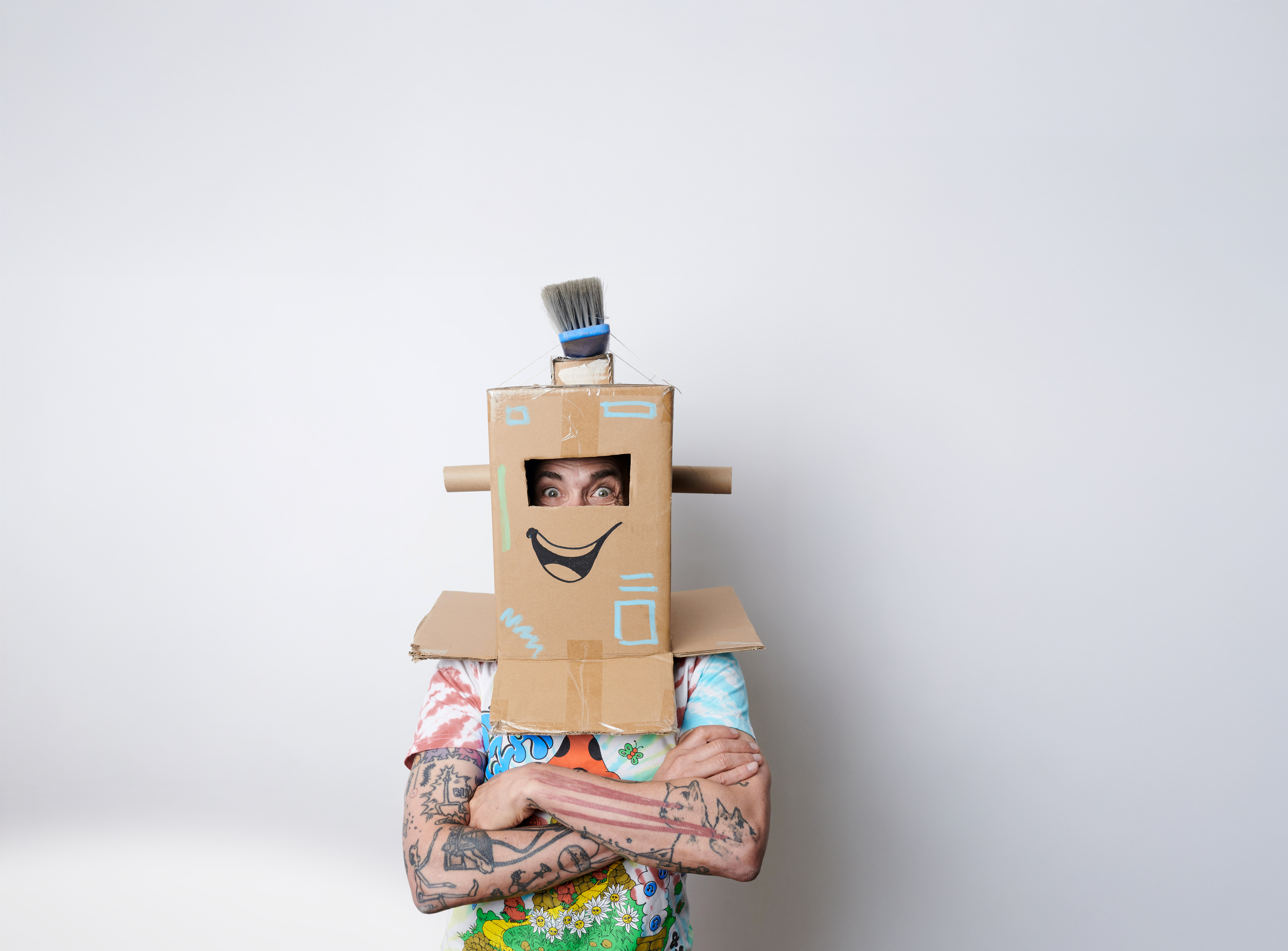
CJ: How do you think authors can convey an authentic representation of diversity without being accused of being performative or just ticking boxes?
Andy: I did have one kid in America ask me, ‘Will you ever be including a transgender character in your books?’ And I went, ‘Well, I’m not going to just put a token character in, because I’m writing from my experience, and with my friends Terry and Jill, and we’re writing what’s true to us.’ But it did increasingly bother me, and that’s why the new series with illustrator Bill Hope, You and Me, features two characters who are genderless … they’re completely covered head to toe with their adventure suits. Kids had been asking me to put them in the book – I was really working on that problem. How could I represent all readers as one single character, as one you?
Because I write to an imagined you. But yeah, Bill Hope helped me solve it, just by saying, ‘We’ll put a cardboard box on their head’ … But the other thing we did was to populate our worlds with non-human characters. By using animals and other objects as characters, we sidestep issues of representation. So that’s my solution. You can’t do it tokenistically, because kids will pick you for a fake like that. So it has to be real. It doesn’t have to be moralistic – and that’s something I steered away from as a kid. Any book that smelled of worthiness, I was like, ‘uh-uh.’ I think story is of prime importance; just once upon a time, and you sweep them up and take them into that world of adventure and imagination.
Andy: When I first started writing … I tried to be a ‘serious writer’. I was like, ‘Oh, I better put all this silliness aside now and write properly.’ But it just wasn’t in me. Anything that was worth reading that I wrote was always amusing or it had some left-of-centre, wacky angle. And I just, after a while, went, ‘Oh, I’m never going to be a serious writer. I must be a clown. All right, I’ll lean into it’ … I think that’s what made the kids respond to it at a very deep level. They just went, ‘This guy’s nuts. We love him, you know, because he’s not trying.’
CJ: They love the authenticity of it. I mean, that’s what you were saying about diversity and that’s what you’re saying about writing in general, isn’t it? That you’ve got to be authentic, number one, right?
Andy: Yeah. Attend to authenticity. That is your main problem as a writer, whether it’s for children or adults. I feel like if I’m having fun and genuinely amusing myself and co-writers then I trust that enjoyment will transmit to the reader.
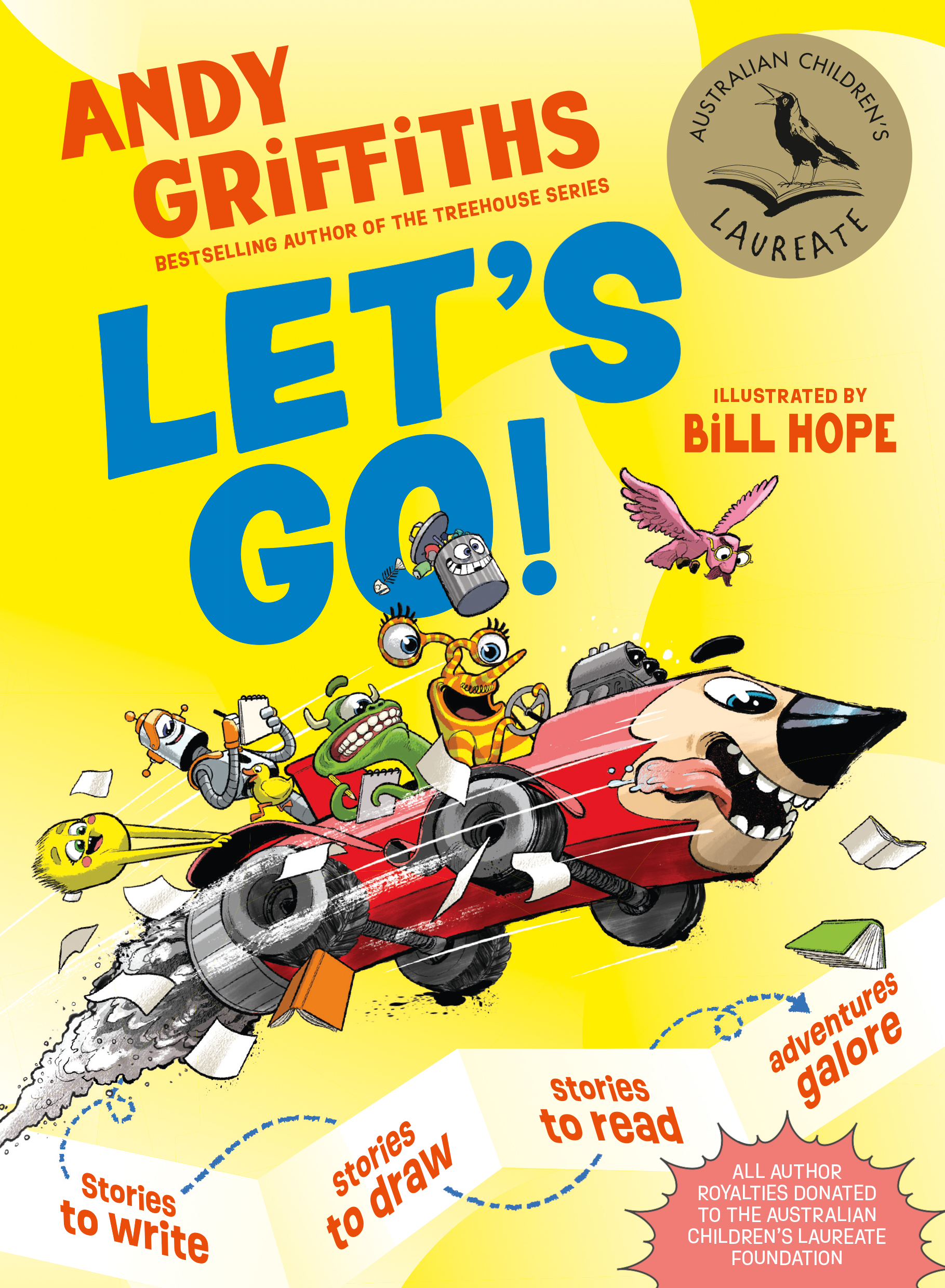
Andy Griffiths is the Australian Children’s Laureate 2026–2027. His books include the JUST! books, the Treehouse series, Let’s Go!, and the YOU & ME series, the latest of which, You and Me and the Gigantic Knucklehead, will be published on 28 July.