Issue 137
Term 2, 2026
Yours Troolie, Kate Temple
Author Kate Temple’s thoughts on current issues in children’s literature.
Is there ever a place for censorship, in particular in the context of school libraries?
In a world where book banning has been regularly in the news, Kate Temple finds the idea of censorship very concerning. However, in the context of school libraries, a nuanced approach is needed: ‘I don’t believe in censorship broadly … It’s not censorship to think about whether or not a book is age appropriate for a child.’
Who makes the decision about what’s age appropriate for children?
In a school library setting, Temple observes that there is a range of professionals who are gatekeepers. Parents are the first and most important voices, but teacher librarians often understand the landscape better than most – they know what books are out there, why they’re out there, what’s doing a good job of imparting a particular message. Being thoughtful about choices is really important: ‘Taking a moment to go, well, is this the best way that we can explore this issue? And fortunately, there are so many books that explore difficult issues very well.’
What about community values and inclusivity?
Temple says that libraries should be safe spaces for all students, and places where all families and all people can find something that reflects them, their lives and their families. Showing representation in a library isn’t just for the benefit of any one group – it also benefits the whole community: ‘It’s vital to have a range of different families, different people, different lifestyles in the book, and not in a way that is didactic, but just in a way that’s really incidental because that’s what life looks like.’
As for the criticism that children’s books are preoccupied with inclusivity – and virtue signalling – Temple says this is an incredibly naïve view that suggests ‘people are not reading these books, because you would only have to open these books to see these are interesting stories … that are telling a greater narrative and those elements of diversity are just part of the story and they are part of life.’
What could we see more of in children’s literature?
Temple has been told by lots of her readers, particularly girls, that they love Alice Toolie and her incredible energy and vision. Alice’s belief that she has everything under control – when she often doesn’t – makes her character realistic, fallible and very funny. Temple is always looking for ways to give her girl characters different roles to those they often have in books:
‘I don’t think there are enough funny girls out there … And when I talk to kids in schools [about this], the girls are immediately like, “Exactly. We agree with that. There are not enough funny girls in books.” And I always say to girls, “Well, there should be, because we’re hilarious.” And they agree, because girls are hilarious. And I think there needs to be more kinds of funny girls, because the [only] two you get are the clever, wry humour girl or the real, There’s something about Mary stumbly kind.’
Did you really say that Mega rich guinea pigs teaches children about the ethics surrounding late-stage capitalism!
In an internet culture with creators like Mr Beast who promote an aspiration for money that is totally out of sync with real life, Temple feels that Mega rich guinea pigs is a way of talking to kids who watch that content and asking them to consider it critically.
She started noticing the obsession with billionaire culture on school visits and thought it was really interesting. ‘And what we love to do is use fun and humour and fiction to unpack those kinds of themes. So it sort of pulls apart what is the value of money … how much money is enough, and does anyone ever really deserve to have so much money?’ Temple admits that some of these ethical issues are dry and hard to get into, ‘But we’re looking at the ethics of billionaire culture through the lens of guinea pigs. And … there aren’t a lot of [children’s] books that talk about money and kind of question it critically.’
How do we approach sensitive or tricky topics with a children’s audience in mind?
Temple emphasises that there are many books for children that explore difficult issues very well, and that different age groups require different treatment: ‘often very subtly for a younger audience or within an allegory … and then there are much more pointed ones, which in older stages is appropriate as well.
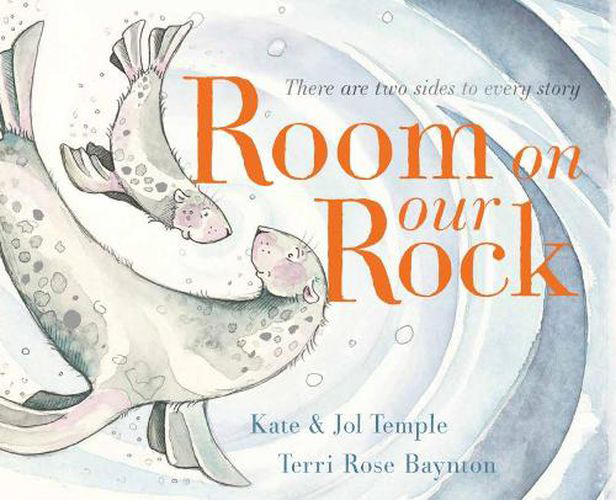
For example, our book Room on our rock (Temple & Temple, 2018) and the picture book The Mediterranean (Greder, 2018), they’re on the same topic. One is so much heavier and could be inappropriate for a really young audience, but they’re both unpacking the same issue.’
Some final praise for teacher librarians and library staff
‘I think we’re just so fortunate, you know, to have teacher librarians where we do because … they do think very deeply about their collection. They do consider the issues. They are completely aware of what’s age appropriate for kids and I think, without that thought that a teacher librarian brings to the literacy that’s available to their cohort, you’d really be in trouble because they do take these issues very seriously and think about what is on their shelves.’
References
Greder, A. (2018). The Mediterranean. A & U Children. Temple, K. & Temple, J. (2025). Bin chicken lights up the night. Scholastic Australia.
Temple, K. and Temple, J. (2018). Room on our rock. Scholastic Australia.
Kate and Jol Temple are the authoring duo behind more than 40 books for kids, from the best-selling Bin chicken series to the new middle grade book Mega rich guinea pigs. Kate has also written, solo, the middle grade novels The dangerous business of being Trilby Moffat and The perilous promotion of Trilby Moffat.