Issue 138
Term 3, 2026
The art of inclusive storytelling with Lili Wilkinson and Campbell Whyte
If we broaden what we mean by storytelling, we broaden who can be included. Lili Wilkinson and Campbell Whyte explain how diverse storytelling formats can make storytelling accessible to a wider audience.
Before reading and writing, there was storytelling. Ever since people began gathering together, storytelling has been used as a way to communicate moral, social, educational and cultural messages. In whatever form they come, stories invite readers into other lives and perspectives. Library staff can maximise accessibility to stories by providing opportunities for students to interact with a range of storytelling forms. Offering a variety of formats is not just about preference, but also about equity; and promoting storytelling in diverse formats validates and endorses diversity itself. This includes validation of diverse creative processes, diverse preferences and diverse readerships.
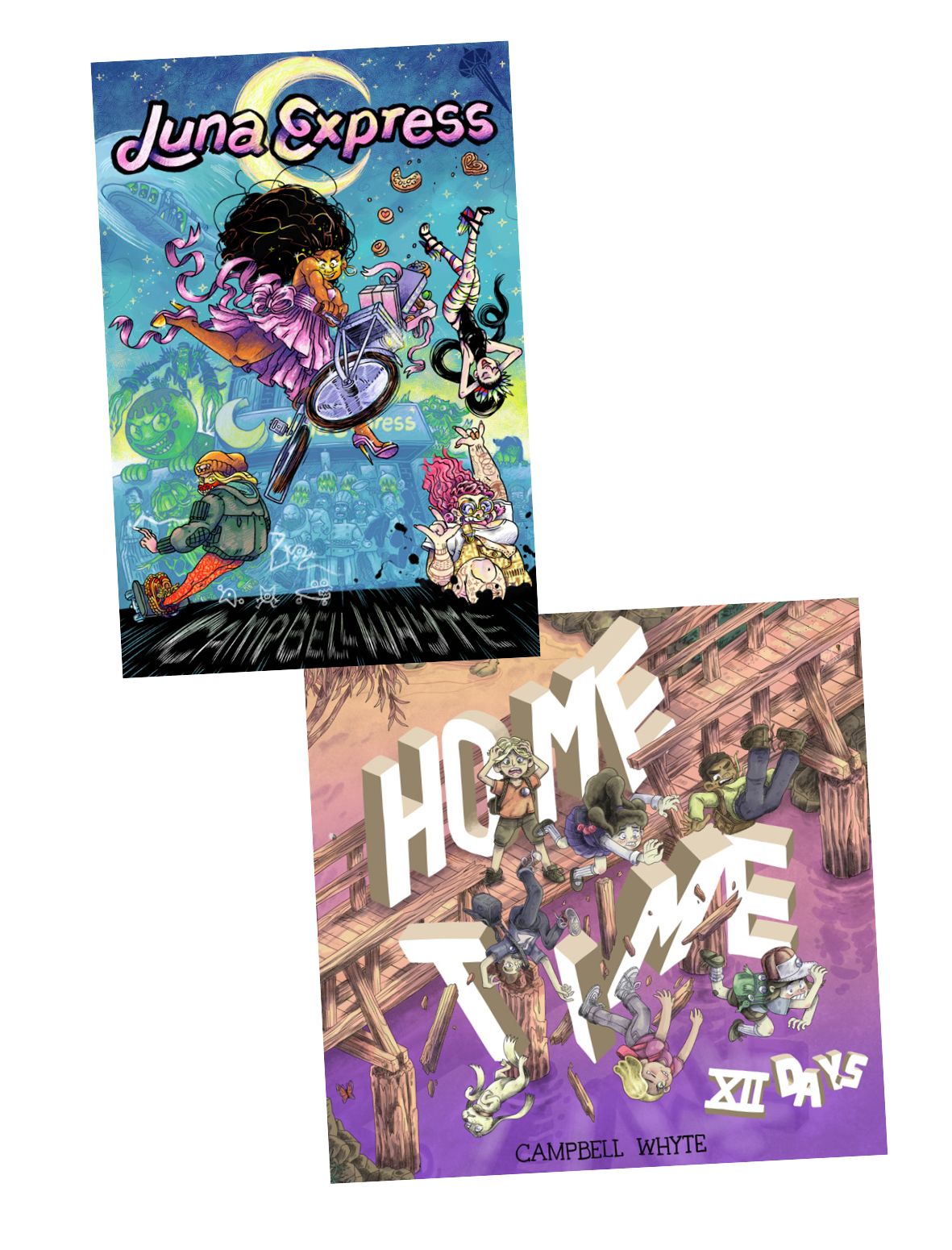
Storytelling and words
Thinking about the history of letters and words, the first iterations of these were often pictorial – Egyptian hieroglyphs, Chinese and Japanese characters, and so on. Campbell Whyte, a graphic novelist, explains ‘if we look throughout the history of the civilizations, the image has been the primary communication tool. It predates the written form in any sense. It predates especially print type. When books were handwritten, you know, there was still about half imagery. If you look at illuminated manuscripts throughout Europe, or texts that were hand transposed, they still had huge amounts of imagery in them. It’s only once typesetting became a thing in the printing press that we went, oh, let’s just like go full text! And so I think the graphic novel, or the comic, is almost a much truer form of writing.’
In this sense, we can see that reading a comic or graphic work has an intuitive logic to it, though Whyte cautions that this shouldn’t be mistaken for simplicity. ‘I think definitely in the West, we historically have always treated images in literature as sort of a training wheel for literacy, where, as you get older, you require the training wheels of imagery less and less until finally we reach literature’s “final form”, which is just pure prose. But I think that’s really a narrow and backwards way of thinking about it.’ Whyte emphasises that just as a prose text for a younger reader may be laid out or sequenced in a simple, clear way, often graphic novels and comics for younger readers are too; but graphic works for older readers and adults can be quite complex.
‘A friend of mine was showing one of their friends the comic that they were developing and this person had never really read a comic before and they had to ask, “which order do I read the panels in? And with the speech balloons, which order do I read them in?” And this was an adult. And so, there are reading conventions that are required, and we encounter people who are not comics-literate ... I think when you’re reading comics, there is a lot of what Scott McLeod calls “closure” that’s required for the reader to engage in. And that’s where you have one panel, and then you have a second panel, and between those panels, there’s a gap of time and space in what’s depicted in them. And so the reader has to close that gap between the two. There’s this active imagination that’s required. And sometimes the gap between the two panels in time and space is quite small and quite obvious. And other times it’s larger and requires more of a creative leap in terms of the reader’s active role in it, and so you’re having to parse not just the written form, but also a visual language at the same time. So it definitely sparks and requires a different type of reading. And I think it’s because it’s this sort of transliterary form, I think it’s really engaging for a lot of people. You know, it kind of engages multiple parts of your brain in the way that often children’s books for children do, where there’s this text and there’s imagery.’
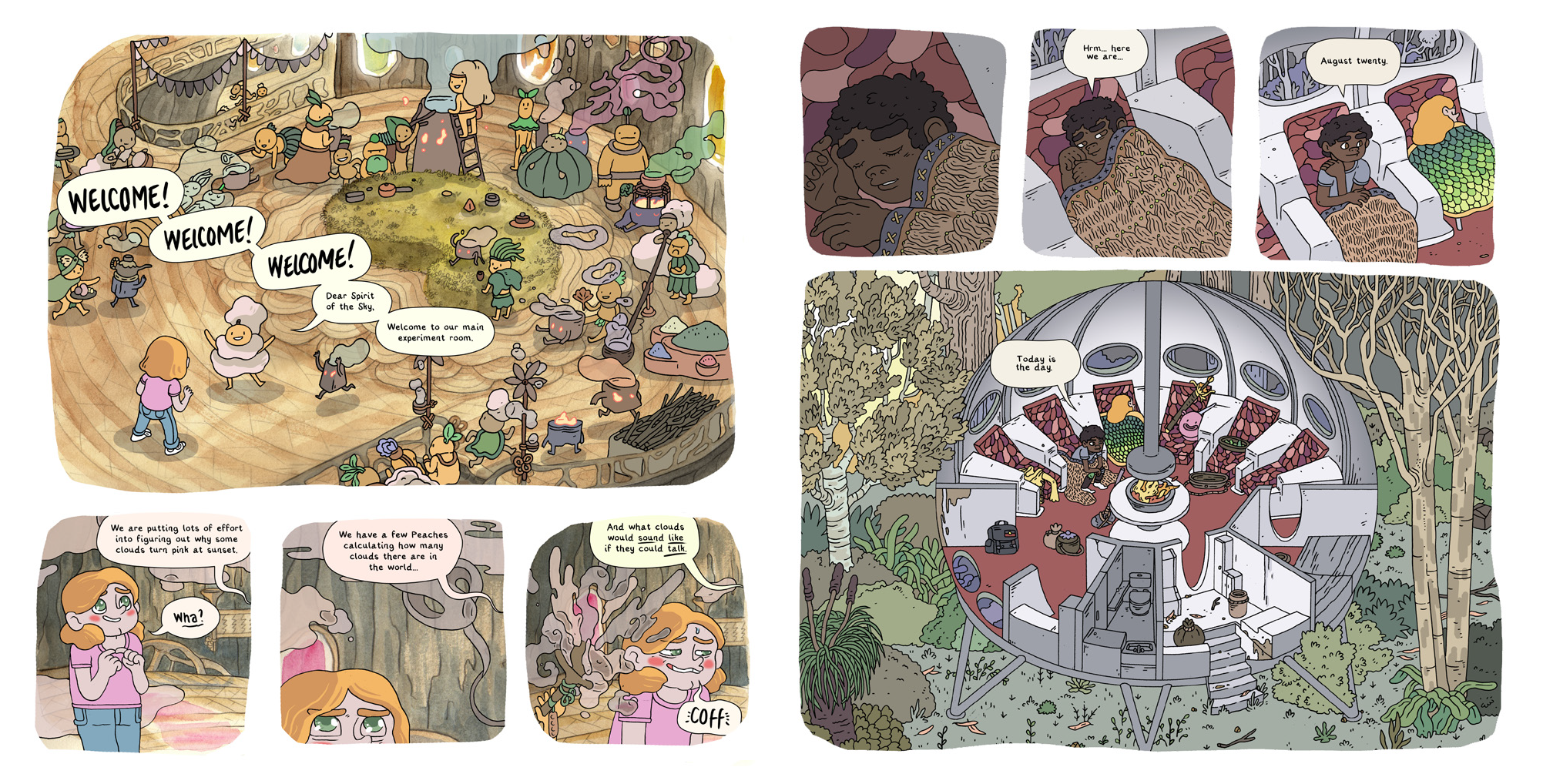
Pages from Home Time by Campbell Whyte
Vocabulary is the glue that holds stories, ideas, and content together to make reading comprehension possible for children.
- University of Oregon, Center on Teaching & Learning
Storytelling in comics and graphic novels can be quite poetic, in the sense that as in a poem, word choices have to be succinct, precise and curated. Unlike prose, comic text is limited. In terms of word count, a graphic novel may contain the same number of words as a short story, but it may encompass or express a novel-sized concept.
Whyte says, ‘I also do things that I kind of refer to as comics poems, which is kind of an exercise both in text and imagery in terms of how much I can pare back and still communicate an idea. So that’s really like an active exercise in cutting everything right down. And that’s really informed both practices. It’s informed the long form work as well, because ultimately it is this act of refining things down. And there was a research project at the University of Oregon1 a while ago trying to look at the use of words in comics and they were comparing comics, children’s books and adults books and they were wanting to look at the “rare word per thousand ratio” – that’s the linguistic importance or uniqueness of words that are in a text. And children’s books were averaging 30.9 rare words per thousand. And adult prose books were 52.7, but comic books were averaging 53.5. So they found comic books were averaging a higher rare word per thousand count than adult prose novels. And I think it’s because of exactly what you’re saying. You know, you’ve got so few words, you’ve really got to choose them. And if you’re choosing them ... so specifically, you’re going to choose interesting ones generally.’
Multimodal literacies
Graphic narratives, in particular, also remind us that reading is not only about decoding words. Readers today need to be versatile in applying their skills to both print and digital texts; they must interpret images, infer meaning between panels or text boxes or sections on a website, and often navigate multiple modes simultaneously. These days, storytelling is used to engage consumers in advertising, gameplay, current affairs – and even onboarding new clients or filling out forms – by positioning the reader or viewer as the ‘protagonist’ on a ‘journey’ or quest, fulfilling tasks to complete a mission or narrative arc. Often storytelling in one format borrows techniques and ideas from another: for example, graphic novel writing can be like making a movie, says Whyte. ‘Oftentimes what people will do is they’ll write a script, which is sort of like a movie script in terms of it’s got some stage direction, but it’s mostly dialogue and it’s broken down into scenes. That’s a really common way for comics to get made ... so they start from a prose foundation. I don’t do that. My process is a lot more kind of intuitive and iterative – usually my projects start with a few key ideas and I spend a long time developing up the visual language because that’s primarily how I think. I spend a long time developing up imagery, developing up characters, developing up key plot ideas. And then once they are kind of starting to solidify and become a bit more firm, that’s when I sit down and I start mapping out like a story structure, like a narrative structure. And then once I’ve got that narrative structure really firm, then I start with the storyboards ... but I won’t actually write the dialogue until ... the artwork’s finished. So, I know what the characters are saying, but because I do the art and the writing, I actually really enjoy that process of visually working through a scene with the characters, and it sounds a bit crazy, but it feels ... like working with actors, where, like, I’m visually drawing them. And as I’m drawing them, I’m like, “oh, actually, they would enter the room like this, and that’s going to change the scene in this way”. Or the visuals start communicating with me in the way that the characters are engaging and interacting with each other. So that can change the story, and that can change a scene.’
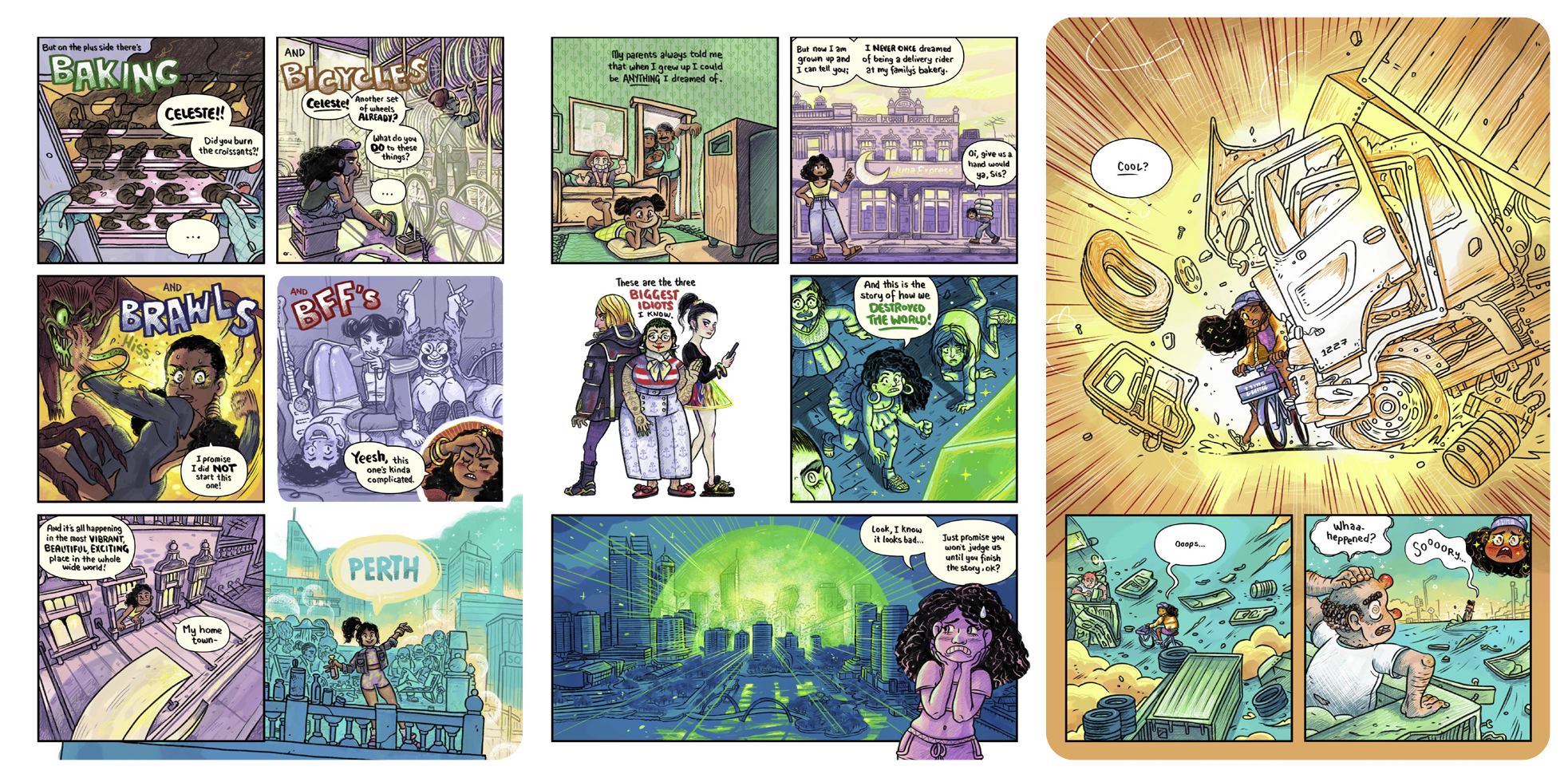
When it comes to engaging students with stories, novelist Lili Wilkinson says we must be open about the possibilities of what ‘storytelling’ can mean. ‘I do some freelance writing for gaming, and those stories are carefully crafted as well. And whenever I do a writing workshop, I often start by asking the kids to share a story that they enjoyed recently and to tell me about it.
As long as I can remember reading, I remember reading comics: they’re not separated from other reading practices for me. It’s sort of all the one thing.
- Campbell Whyte
And I make sure at the beginning to [stress that] story is anything with a narrative. It doesn’t have to just be a book. So if you haven’t read a book lately, tell me about a movie, tell me about a great video game you played that had a story that engaged you. And it’s amazing how more responses you get.’
Wilkinson also feels strongly that engaging storytelling gives students an understanding of concepts and ideas that traditional school texts may cover, but in a less appealing or contemporary way. ‘It’s about meeting kids where they are. Yes, you want all of those opportunities to be able to analyse texts, but I feel like engaging kids and developing a love of reading, that lifelong love of reading, should also be in the mix.’
Expanding our idea of what storytelling can look like and be in these ways gives us many more chances to engage students with literature and respond to their particular interests. Graphic novels and comics are a huge part of this. Whyte says, ‘There was a great research project recently that was supported by Creative Australia called Folio, where they were looking at Australian comics across the country, and they did a roundtable with four librarians from across the state. And, [these librarians], they were responsible for multiple libraries, most of them reporting, graphic novel collections are by far the most borrowed part of all of the collections. And then the next thing was children’s books, you know. So if you look at like, what the public is actually engaging with.’
Engaging not just students but the whole school community with story and storytelling can be very powerful too, says Wilkinson. ‘I love the [CBCA Children’s Book Awards] shadow judging. It’s the closest thing we have to the Inky Awards. I love having young people have a bit of agency. It gives libraries a way to participate as well, like school libraries, public libraries. Having their own shadow judges, going through that process themselves, [and saying, this] school has picked this winner. There’s an enormous amount of value in that. It brings those awards back into relevance. When I was a nerdy tween, it was like the Oscars for me, waiting for that shortlist to come out. These days, there’s so much competing for a child’s attention, you’ve got to find ways to keep it dynamic, to keep it participatory.’
Storytelling as a way to communicate political and social ideas
In her PhD, Wilkinson looked into how we communicate ideology to young people, while still leaving them space to come to their own conclusions. In her work, she says, ‘I try not be didactic. There’s nothing that kids hate more than being told what to think. So I try to create a space that encourages them to ask questions. A reviewer once said, if Lili Wilkinson’s books have a theme, it’s to never trust authority. I hadn’t thought about it that way, but I guess it’s true. Never accept anything blindly. Always be a critical thinker. Engaging young people and giving them agency over what they read is so important.’
Storytelling also allows people to engage with creativity in a joyful way that counteracts the social perception we develop as adults that we must only pursue activities that we are ‘good’ at, says Whyte. ‘When [we’re children], we all dance and we all sing and we all play make believe and we all dress up and we’re at our most honestly weird and interesting. And over time, that sort of gets suppressed a little bit – for all sorts of reasons, like often in a classroom environment, there’s one person who’s the one that’s good at singing, and there’s the one that’s good at sport, and there’s the one that’s good at maths, and there’s the one that’s good at art. And oftentimes within that competitive social environment, people perceive that there’s only space for one.’ Storytellers allow us to step back into that creative space and engage with it again.
Dystopian storytelling can be appealing, especially to young people, because the characters have agency in disastrous situations, whereas in everyday life, kids may feel they have little or no agency. Dystopian stories help with processing this reality. Wilkinson observes, ‘High school is kind of like a dystopia. You have to dress a certain way and you are told what to think. All of your movements are controlled by the ringing of bells. I think that it is always going to be a bit of a touchstone for teens.’
Book Week as a celebration of storytelling
Wilkinson describes Book Week as a way of celebrating storytelling that can involve everyone in the school community, but that it can be especially powerful for those students who may not connect as well with other aspects of school life. ‘The dress-up parade works really well. I see less of them in high schools, but teenagers love an excuse to dress up. Author visits work really well, too. I think the best model is where the author speaks to a large group of kids, and then does a workshop with self-selected students. The ones who really want that experience. Once at a public school in Cairns I did a full day workshop with self-selected kids. And this Year 10 boy said to me at the end, “I am not a sporty kid. I’m not particularly musical. I don’t act. This is the first time there’s been something special at school that was for me.” Right in the feels!’ She goes on to say, ‘We don’t often celebrate reading. I go to the assembly at our kids’ school and they talk a lot about sporting achievements and stuff. How do we celebrate reading in that way? I think Book Week is really good for that. Maybe some reading challenges over the year, how many books can you read or how many words can this class read? And then give out prizes for the best ones. Find some ways of celebrating writing and reading in a way that everybody can contribute to … It’s important to highlight books, but if you lower the barrier for entry – if you make it storytelling – then you can include narratives in games and in film and TV. There are ways to do that that allow everyone to participate but still hold books up as being both important and fun.’
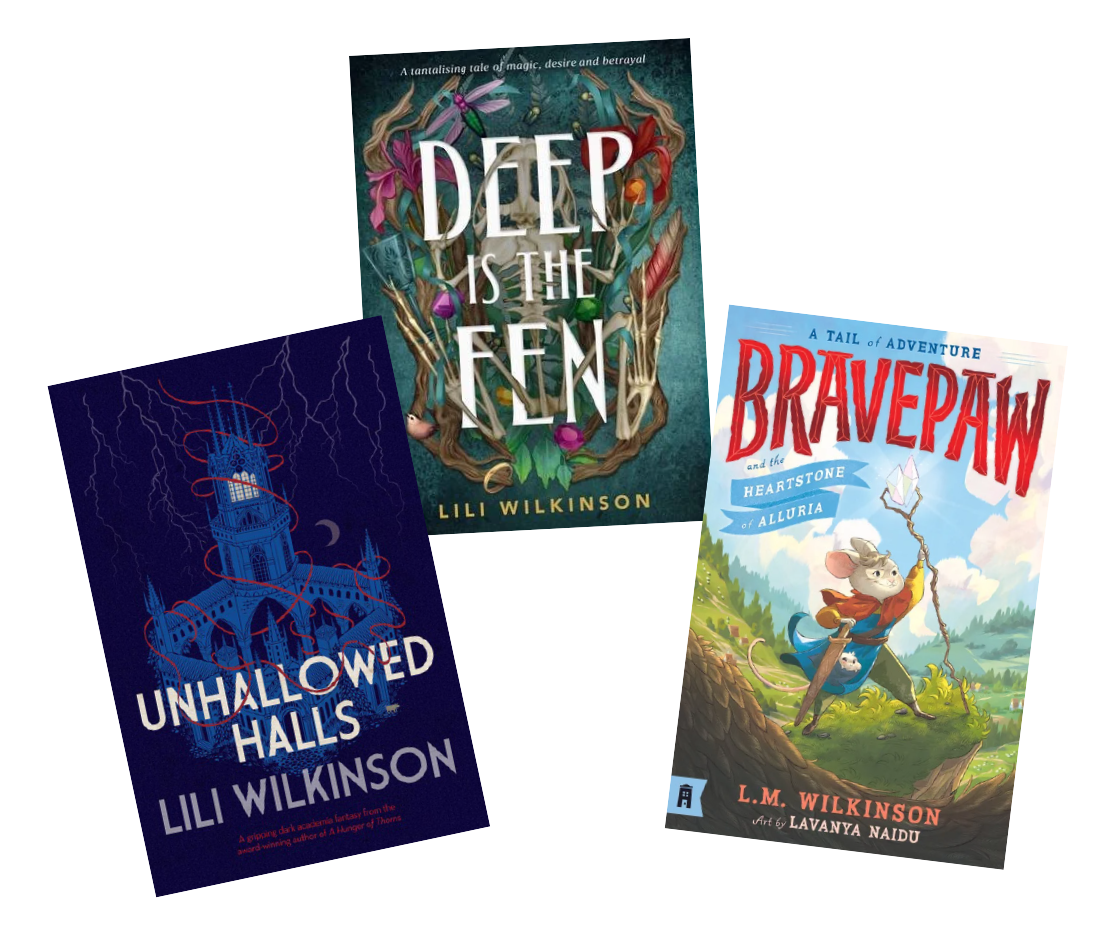
Cambridge University Press. (2026). Vocabulary simplification for children: A special case of ‘motherese’?
Creative Australia. (2026). Folio: Stories of Australian comics
Folio Comics. (2026). Folio comics
University of Oregon. (2026). Big ideas in beginning reading: Overview
University of Oregon. (2026). Big ideas in beginning reading: Vocabulary

Lili Wilkinson
Australian children's author and educator

Campbell Whyte
Graphic novelist
Co-founder, milktooth school of art and stories